



Origins
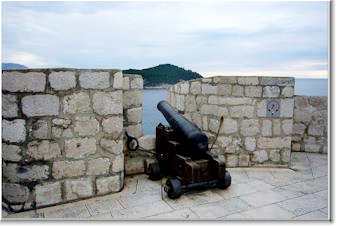
Dubrovnik was originally called Ragusa and was formed in the 7th century when coastal residents took refuge there under the onslaught of barbarian invasions. Walls were quickly built to protect the new settlement.
Rise
Over the next four centuries Ragusa expanded its influence over the coast and became increasingly prosperous by trading with other Mediterranean cities. In 1205 it fell under the control of Venice but it managed to break away in 1358.
By the 15th century the Republic of Ragusa was a major rival of Venice for control of the Adriatic waterways, trading with the Near East and Europe. It maintained its independence through canny diplomacy and used its wealth to expand its cultural and political influence.
Earthquake
In 1667, Dubrovnik was devastated by a major earthquake which destroyed most of its Renaissance art and architecture. Only the Sponza Palace and the Rector's Palace survived the destruction. The city was reconstructed in the baroque style that you see today.
Fall
|

After the earthquake, Dubrovnik fell into decline, hastened by the emergence of other European naval powers. It was Napoleon who finally put an end to the republic in 1806 when he entered the city and announced its annexation. In 1815, the Congress of Vienna ceded Dubrovnik to Austria to whom it remained attached until 1918.
Dubrovnik began to develop its tourist industry in the late 19th century. Luminaries such as Lord Byron, George Bernard Shaw and Agatha Christie were awed by the town and Dubrovnik began developing its tourist business.
World War II
With the outbreak of WWII, Dubrovnik and the rest of Croatia fell under the control of the Axis powers. Italian forces occupied Dubrovnik from 1941 to 1943 at which point the city was passed to the Germans. Marshal Josip Broz Tito's Communist Partisans formed the only effective resistance to German occupation and the city was liberated in 1944.
In the bitterness and confusion that followed liberation, a massacre of 48 Nazi sympathizers took place on the island of Daksa, north of Babin Kuk. One of the victims was the town priest who also happened to be mayor during the occupation. The locals were told that the same fate awaited anyone who reported the crime and so the bodies lay unburied for decades. No one was ever charged for the crime and it is said that the island is haunted. Now privately owned, the deserted island is up for sale but no one is buying.
The Bombardment
In December 1991 the world watched in horror as Serbian and Montenegrin gunners trained their artillery on the beautiful, historic city of Dubrovnik. As it was without military value, the only purpose seemed to be to break the morale of the Croatian people by destroying the Adriatic's most historic city.The shelling of 1991 lasted intermittently until June 1992 and caused substantial damage to the roofs, the marble streets and the Renaissance sculpture. Fortunately UNESCO and other international organizations rushed to the rescue. Teams of skilled workers laboured throughout most of the 1990s and now the treasures of Dubrovnik are beautifully restored. Read more about the 1991 bombing of Dubrovnik.
 Dubrovnik Travel
Planner
Dubrovnik Travel
Planner  One Day in Dubrovnik
 Bombing of Dubrovnik
 Croatian History
Rich Ragusa needed a strong defense
Join the Croatia Traveller Group
Recommended Experiences
©CroatiaTraveller 2005-2024 All rights reserved
