

History of Hvar Island

FOLLOW! 


The first inhabitants of Hvar Island were neolithic people who probably established trade links between Hvar and the eastern shores of the Mediterranean.
Around 385BC, Greeks from the island of Paros, aided by Dionysius the Elder and settlers from Issa (now Vis Island) founded the agricultural colony of Faros (now Stari Grad).
The local population conflicted with the Greeks and, in the oldest historically confirmed naval battle, the Greek navy from Issa devastated the islanders even with reinforcements from the mainland (around 365BC).
After the first Illyrian War of 230BC, a Greek ally of the Illyrians made Faros the centre of a confederation of several nearby islands. He was defeated by the Romans in the battle of Faros in 219BC. The town was razed to the ground and never recovered. The only trace of this ancient town which remains are the ruins of the Greek walls.
The most interesting reminders of the ancient Greeks is the Stari Grad plain, a UNESCO World Heritage Site. The plain is a land division laid down by the Pharians that is so well-preserved, it's even visible by satellite. Each colonist received a plot of land measuring exactly 906 x 181 meters upon which they grew grain for subsistence and export.
In the 7th and 8th centuries, the Slavic Neretlyan tribe dominated the island but as the centuries rolled on Hvar came to know a long series of rulers. In the 9th century, the island fell under Byzantine rule and in the 11th century Hvar became a part of Croatia's King Petar Kresimir.
The first intrusion of Venice onto Hvar Island occurred in the 12th century but it was not to last. Again came Byzantium and then the Croatian kings (from 1180 to 1278).
At the time, the pirates of Omis became a growing threat on the Adriatic coast. Hvar couldn't go it alone against the pirates so they turned to Venice for protection. Venice was only too happy to oblige.
In 1331, Hvar became officially part of the Venetian empire although Venice's rule was shaky at first. Hvar accepted the rule of the Croatian kings again, then Bosnian King Tvrtko and then in 1413, the Republic of Ragusa (Dubrovnik).
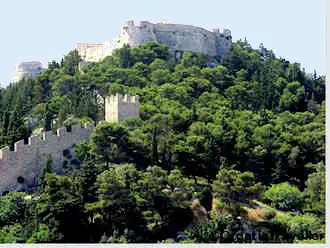
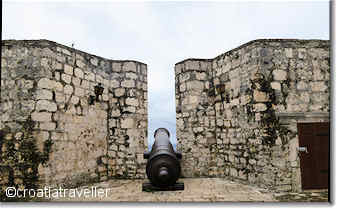
The Venetians moved from Stari Grad to Hvar town in the middle of the 15th century in order to take advantage of Hvar's wide, sheltered harbor. They protected their investment by building a defensive system of walls and fortifications on the landward side of Hvar town. Although the Venetians lasted until the fall of the republic in 1797, their rule was rocky. In the 15th century there were violent clashes between the Hvar commoners and the aristocracy. The most serious uprising occurred from 1510 to 1514 but Venice crushed it ruthlessly and twenty rebel leaders were hanged.
The island became prosperous from fishing, boatbuilding and cultivating lavender, rosemary and olives. It reached its heyday in the Renaissance when its riches attracted poets, writers and scientists.
After the fall of Venice in 1797, Hvar's destiny followed that of the rest of Dalmatia.
Further ResourcesAll about Hvar in Croatia Traveller's Dalmatia: Split to Dubovnik
Accommodation
Related Pages
|


 Hvar Travel Planner
  Hvar Town
 Croatian History
  Accommodation
 Dalmatian History
Join the Croatia Traveller Group
Recommended Experiences
©CroatiaTraveller 2005-2024 All rights reserved
